Communication and collaboration are keys to our growing business, partly because we communicate for a living but also because we are a small business with colleagues and clients across the country.
Kristen and I are constantly working on how we do better business, so last fall we tackled the big question: how do we create a culture where people share their strengths and acknowledge their weaknesses for the betterment of the team and our clients?
For years, Kristen and I have followed Patrick Lencioni’s work – he’s written a few great books we’d highly recommend, from The Five Dysfunctions of a Team to The Ideal Team Player and The Advantage. They all start with his famed fable that makes business books much easier to read and actually enjoy.
Then we found his latest concept called The 6 Types of Working Genius. It’s been a game-changer for us ever since. First, we read the book, but there’s a great podcast to listen to, and we took a class to get certified to teach, which was a great addition to our annual retreat.
The Working Genius helped Kristen and me be better partners to each other and to our clients and better leaders to our team. A few of us even dabbled with the concept in our personal lives as well.
You might be wondering, is this just another assessment like the DISC or Myers-Briggs? No, we’ve done all of the assessments, and while they all serve a purpose, this one is different. Unlike the others, the Working Genius measures your work style as an individual, but also how you fit into a team dynamic where people have different strengths and weaknesses and can complement each other.
Common Language
For our team, Working Genius provided a common language to describe our strengths and weaknesses and our roles on the team. We now regularly hear Working Genius vocabulary being used to explain why someone may have missed something in a conversation or seemed frustrated during a meeting, why a project didn’t go as it could have because we hadn’t read the client correctly, why a certain person doesn’t always mesh with another on the team or how a missing working style is missing in a group and is creating an issue for the team and/or client.
The Working Genius doesn’t give anyone an “out” to being a better colleague but allows us all to understand each other, structure our meetings for optimal success, and consider who is on our team to optimize results.
Meetings
We have now started approaching meetings differently, knowing that people’s Working Genius’ play into how they handle meetings. We found out we were having something Lencioni calls meeting stew – meetings with everything from tactical to strategic in one meeting. He talks about teams needing four different types of meetings to achieve the best results.
Four types of meetings:
- Daily check-in/Huddle – once a day for 5-10 minutes to go over really tactical information
- Weekly tactical – once a week to discuss priorities and short-term tactical information
- Ad hoc strategic – regular meetings designed only to brainstorm or solve a big problem
- Quarterly off-site – quarterly meeting to step back from the business and assess big strategic questions about the business
We now know that we need meetings designed for our T’s (tenacity) to ensure we are checking boxes and getting results, as well as our W’s (wonder) and I’s (invention), which are more brainstorming and creative. It’s still very much a work in progress, but we’re more mindful.
Bus Concept
One of the biggest things Working Genius did for us as leaders was to help us understand the bus concept and apply it. Conceptually, we understood why we’d need different people in different seats, but this helped us place our team in those seats by identifying our team’s strengths and weaknesses, thinking through how to manage them, and how to think about the team as a whole.
The Working Genius Overview
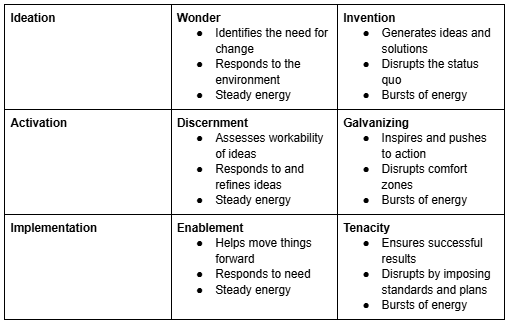
The 6 types of Working Genius is a model that helps people discover their natural gifts and thrive in their work and life. When people are able to better understand the types of work that bring them more energy and fulfillment and avoid work that leads to frustration and failure, they can be more self-aware, more productive, and more successful.
Working Genius identifies the six fundamental activities that are required for any type of work and where people naturally fit into them. Below are the 6 geniuses and generally how they operate.
Resources
Let us know if you have any questions; we’re happy to share our experience!
-Kirsten Kukowski, K2 Partner